
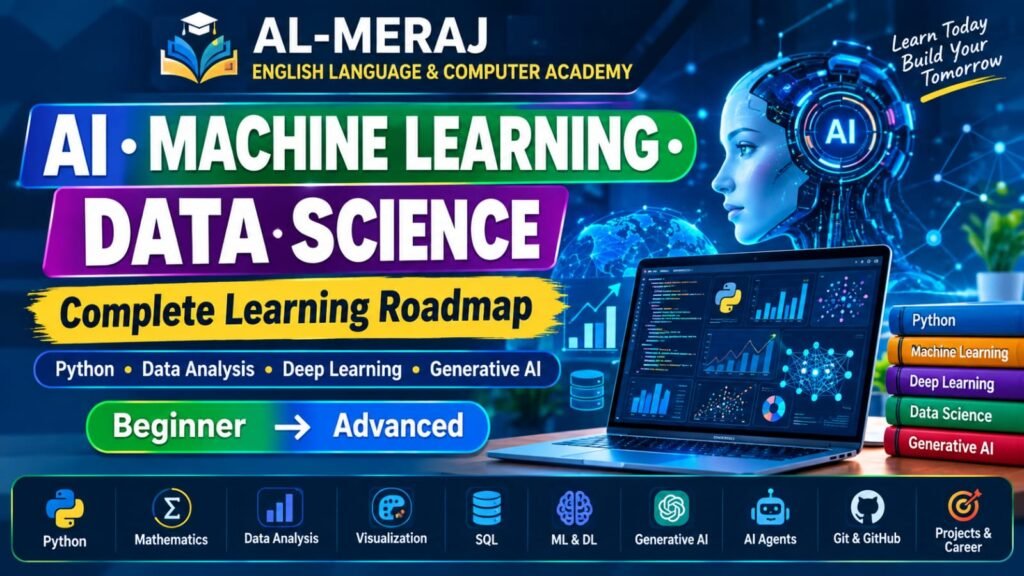
AI, Machine Learning and Data Science Roadmap 2026: Complete Beginner-to-Advanced Guide
Artificial Intelligence (AI), Machine Learning (ML), and Data Science are transforming the way businesses, organizations, and individuals use technology.
From healthcare and banking to education, cybersecurity, e-commerce, software development, transportation, marketing, and automation, these technologies are being applied across a wide range of industries.
However, starting a career in AI or Data Science can feel overwhelming.
Should you learn Python first? Do you need advanced mathematics? When should you start Machine Learning? What about Deep Learning, Generative AI, Large Language Models, AI agents, SQL, GitHub, and MLOps?
This AI, Machine Learning and Data Science Roadmap 2026 provides a structured path from beginner fundamentals to advanced AI topics.
Whether you want to become a Data Analyst, Data Scientist, Machine Learning Engineer, AI Engineer, or Generative AI Developer, this guide will help you understand what to learn and in what order.
What Is Artificial Intelligence (AI)?
Artificial Intelligence is a field of computer science focused on creating systems capable of performing tasks that normally require aspects of human intelligence.
AI systems can be designed to:
Understand human language
Recognize images and objects
Analyze large amounts of information
Generate text, images, audio, and video
Make predictions
Recommend products or content
Automate repetitive tasks
Interact with users
Support data-driven decision-making
Examples include virtual assistants, recommendation systems, chatbots, image-recognition systems, autonomous systems, and Generative AI applications.
AI is the broader field, while Machine Learning and Deep Learning are important technologies used to build many modern AI systems.
What Is Machine Learning?
Machine Learning is a branch of Artificial Intelligence that enables computers to learn patterns from data and use those patterns to make predictions or decisions.
Instead of manually programming every possible rule, developers can provide a Machine Learning system with examples.
For example, instead of writing thousands of individual rules for detecting spam emails, we can train a model using examples of spam and legitimate emails. The model learns patterns from this data and can then classify new emails.
Machine Learning is commonly divided into three major categories:
Supervised Learning
Unsupervised Learning
Reinforcement Learning
For beginners interested in Data Science, supervised and unsupervised learning are usually good places to start.
What Is Data Science?
Data Science combines programming, mathematics, statistics, data analysis, visualization, and Machine Learning to extract useful information and insights from data.
A Data Scientist may work with:
Business data
Customer information
Financial records
Scientific data
Structured databases
Unstructured information
Text
Images
Sensor data
The objective of Data Science is not simply to collect information.
Data Scientists try to understand data, discover patterns, answer important questions, build predictive models, and help organizations make better decisions.
AI vs Machine Learning vs Data Science
Although these fields overlap, they have different primary focuses.
Artificial Intelligence focuses broadly on developing systems capable of intelligent behavior.
Machine Learning focuses on algorithms and systems that learn patterns from data.
Data Science focuses on extracting knowledge and insights from data through programming, statistics, analysis, visualization, and Machine Learning.
In real-world projects, professionals may use technologies and techniques from all three areas.
Complete AI, Machine Learning and Data Science Roadmap
A practical learning sequence for beginners is:
Python → Mathematics → Statistics → NumPy → Pandas → SQL → Data Analysis → Data Visualization → Machine Learning → Deep Learning → Generative AI → LLMs → AI Agents → MLOps → Projects → Portfolio → Career Preparation
Let’s explore each stage.
1. Learn Python Programming
Python is one of the most important programming languages for Artificial Intelligence, Machine Learning, and Data Science.
Beginners should start with the fundamentals.
Python topics to learn
Variables
Data types
Operators
Conditional statements
Loops
Functions
Lists
Tuples
Dictionaries
Sets
File handling
Error handling
Modules and packages
Object-oriented programming
Don’t rush into Machine Learning before understanding basic programming.
Once you are comfortable writing simple Python programs, start learning the libraries commonly used for data and AI.
Important libraries include:
NumPy
Pandas
Matplotlib
Seaborn
Scikit-learn
TensorFlow
PyTorch
2. Learn Mathematics for Data Science
You do not need to become a mathematician before learning Data Science.
However, understanding the mathematical concepts behind Machine Learning will make advanced topics much easier.
Linear Algebra
Focus on:
Vectors
Matrices
Matrix operations
Dot products
Eigenvalues
Eigenvectors
Linear algebra is particularly important when studying Machine Learning and Deep Learning.
Calculus
Learn the basics of:
Functions
Derivatives
Partial derivatives
Gradients
Optimization
These concepts help explain how many Machine Learning and neural-network training algorithms work.
Probability
Important topics include:
Basic probability
Conditional probability
Random variables
Probability distributions
Bayes’ theorem
You don’t need to master everything immediately. Learn mathematics gradually alongside practical Machine Learning.
3. Learn Statistics
Statistics is a core foundation of Data Science.
Important concepts include:
Mean
Median
Mode
Variance
Standard deviation
Percentiles
Correlation
Covariance
Sampling
Probability distributions
Hypothesis testing
Confidence intervals
Statistics helps you understand what your data is telling you and whether observed relationships are meaningful.
4. Learn NumPy
NumPy is a fundamental Python library for numerical computing.
It provides powerful tools for working with:
Arrays
Matrices
Numerical calculations
Mathematical operations
Linear algebra
Understanding NumPy is valuable because many other Python Data Science libraries use it internally.
5. Learn Pandas
Pandas is one of the most widely used Python libraries for data manipulation and analysis.
With Pandas, you can:
Import datasets
Clean data
Filter records
Sort information
Handle missing values
Group data
Merge datasets
Analyze columns
Generate summaries
A common Data Science workflow starts by loading a dataset into a Pandas DataFrame before cleaning, exploring, and analyzing it.
6. Learn Data Analysis
Data Analysis involves examining data to answer questions and discover useful information.
A typical workflow looks like this:
Collect Data → Load Data → Clean Data → Explore Data → Analyze Patterns → Perform Calculations → Visualize Results → Communicate Findings
Data Analysis is useful across industries including finance, healthcare, education, marketing, business, and technology.
7. Learn Exploratory Data Analysis (EDA)
Exploratory Data Analysis, commonly known as EDA, helps you understand a dataset before building Machine Learning models.
During EDA, you should examine:
Dataset size
Data types
Missing values
Duplicate records
Outliers
Distributions
Relationships between variables
Correlations
Good EDA can reveal data-quality problems and useful patterns before modeling begins.
8. Learn Data Visualization
Data visualization turns information into graphical representations that are easier to understand and communicate.
Important chart types include:
Bar charts
Line charts
Histograms
Scatter plots
Box plots
Heatmaps
Pie charts
Popular Python visualization libraries include:
Matplotlib, Seaborn, and Plotly.
Don’t focus only on making charts attractive. A good visualization should communicate useful information clearly.
9. Learn SQL and Databases
SQL is an essential skill for many Data Analysts and Data Scientists because real-world information is often stored in databases.
Learn how to:
Retrieve data
Filter records
Sort results
Join tables
Group information
Calculate statistics
Insert records
Update records
You should also understand:
Tables
Rows
Columns
Primary keys
Foreign keys
Relationships
Queries
Learning both Python and SQL provides a strong foundation for a career in Data Science.
10. Start Machine Learning
Once you understand Python, data manipulation, statistics, and basic mathematics, you can move into Machine Learning.
A simple Machine Learning workflow is:
Data → Cleaning → Feature Engineering → Model Training → Evaluation → Prediction
Machine Learning models can be used for:
Regression
Classification
Clustering
Forecasting
Recommendation
Pattern recognition
11. Learn Supervised Learning
Supervised Learning uses labeled training data.
For example, imagine a dataset containing information about houses together with their selling prices.
A Machine Learning model can learn relationships between features such as house size, location, and other variables and the target value—the price.
The two major supervised learning tasks are:
Regression
Regression is generally used when predicting numerical values.
Examples include:
House prices
Revenue
Sales
Temperature
Demand
Linear Regression is an excellent algorithm for beginners.
Classification
Classification predicts categories or classes.
Examples include:
Spam vs. legitimate email
Fraudulent vs. normal transaction
Customer churn
Positive vs. negative sentiment
Different categories of observations
Important supervised Machine Learning algorithms include:
Linear Regression
Logistic Regression
Decision Trees
Random Forest
Support Vector Machines
K-Nearest Neighbors
Gradient Boosting
12. Learn Unsupervised Learning
Unsupervised Learning works with data that does not have predefined target labels.
Instead, algorithms attempt to discover patterns or structures within the data.
Important techniques include:
Clustering
Dimensionality reduction
Association analysis
K-Means Clustering is a good beginner-friendly algorithm.
Unsupervised learning can be useful for applications such as customer segmentation, exploratory analysis, and pattern discovery.
13. Learn Feature Engineering
Feature Engineering involves creating, transforming, or selecting useful input variables for Machine Learning models.
Examples include:
Converting dates into useful features
Calculating age from date of birth
Encoding categorical variables
Scaling numerical values
Combining existing variables
Selecting useful features
The quality of your features can significantly influence model performance.
14. Learn Model Evaluation
Training a Machine Learning model is only part of the process. You also need to determine how well it performs.
Regression metrics
Learn:
Mean Absolute Error (MAE)
Mean Squared Error (MSE)
Root Mean Squared Error (RMSE)
R² Score
Classification metrics
Learn:
Accuracy
Precision
Recall
F1 Score
Confusion Matrix
ROC-AUC
You should also understand:
Training data
Validation data
Test data
Cross-validation
Overfitting
Underfitting
These concepts are essential for determining whether your model can generalize beyond the data used during training.
15. Data Science with Python vs R
Python and R are both widely used in Data Science.
Python
A common Python learning path is:
Python → NumPy → Pandas → Visualization → Scikit-learn → Deep Learning
Python is also widely used for:
Artificial Intelligence
Automation
Web applications
Machine Learning
Generative AI
R
R is particularly useful for:
Statistical analysis
Research
Statistical modeling
Data visualization
Data exploration
Important R tools and packages include:
RStudio
ggplot2
dplyr
tidyr
caret
tidyverse
For many beginners, learning Python first is a practical approach. R can then be added depending on your field, research requirements, or career goals.
16. Learn Deep Learning
After building a strong Machine Learning foundation, you can move toward Deep Learning.
Deep Learning is a subfield of Machine Learning that uses neural networks with multiple layers to learn complex patterns.
It is widely applied in:
Image recognition
Speech recognition
Natural Language Processing
Computer Vision
Generative AI
Recommendation systems
Popular frameworks include:
TensorFlow
Keras
PyTorch
17. Understand Neural Networks
A basic neural network can contain:
Input Layer → Hidden Layers → Output Layer
Important concepts to learn include:
Neurons
Weights
Biases
Activation functions
Loss functions
Backpropagation
Optimizers
Epochs
Understanding these fundamentals will make advanced Deep Learning architectures easier to learn.
18. Learn CNNs, RNNs and Transformers
Convolutional Neural Networks (CNNs)
CNNs are particularly useful for image-related tasks.
Applications include:
Image classification
Object detection
Face recognition
Medical image analysis
Computer Vision
Recurrent Neural Networks (RNNs)
RNNs were designed to process sequential data and have been used for:
Text processing
Time-series data
Speech
Sequential prediction
Transformers
Transformers have become a major architecture in modern Artificial Intelligence.
They are particularly important for Natural Language Processing and Generative AI.
Transformers use mechanisms such as attention to process relationships between elements in sequences.
They are associated with applications involving:
Language models
Text generation
Translation
Summarization
Question answering
Multimodal AI
19. Explore Natural Language Processing
Natural Language Processing, or NLP, enables computers to work with human language.
Applications include:
Chatbots
Translation
Text classification
Sentiment analysis
Summarization
Question answering
Speech-related applications
NLP is an important area behind many modern language-based AI applications.
20. Learn Computer Vision
Computer Vision enables machines to process and understand visual information.
Applications include:
Image classification
Object detection
Face recognition
Image segmentation
Optical Character Recognition (OCR)
Medical imaging
Computer Vision has applications across healthcare, manufacturing, security, transportation, and other industries.
21. Understand Speech Recognition
Speech recognition converts spoken language into machine-readable text.
It can be used in:
Voice assistants
Transcription
Accessibility tools
Call centers
Voice-controlled applications
Modern systems can also combine speech recognition technologies with language models to create interactive voice applications.
22. Learn Recommendation Systems
Recommendation systems analyze user behavior and other information to suggest relevant content.
They can recommend:
Products
Movies
Videos
Music
Courses
News
Recommendation technologies are widely used by e-commerce and digital platforms.
23. Learn Generative AI
Generative AI refers to AI systems capable of producing new content.
Depending on the model, this may include:
Text
Images
Audio
Video
Code
Generative AI has created new opportunities in software development, education, marketing, design, automation, research, and content creation.
For learners entering AI today, understanding Generative AI should be an important part of the learning roadmap.
24. Understand Large Language Models (LLMs)
Large Language Models, commonly called LLMs, are AI models trained on large amounts of text and other data to perform language-related tasks.
They can be used for:
Question answering
Writing assistance
Summarization
Translation
Coding assistance
Information extraction
Conversational applications
Modern LLM applications can also connect models with databases, APIs, files, external tools, and other systems.
25. Learn Prompt Engineering
Prompt Engineering involves designing instructions that help AI models produce useful outputs.
An effective prompt can specify:
Role
Task
Context
Requirements
Examples
Constraints
Output format
Prompt Engineering can be useful for developers, students, researchers, marketers, business professionals, and content creators.
However, don’t stop at prompting if you want to build advanced AI applications. Combine prompt skills with programming, APIs, data management, model understanding, and application development.
26. Learn AI Agents
AI agents are systems designed to perform tasks using AI models together with tools, instructions, memory, data, or external systems.
A simplified agent workflow might look like this:
User Request → Understand Task → Plan Steps → Use Tools → Analyze Results → Take Actions → Generate Response
For example, an AI agent may:
Understand a request
Divide it into steps
Search for relevant information
Interact with a software tool
Analyze the result
Perform another action
Generate a final response
The capabilities of an AI agent depend on its architecture and the tools and information available to it.
27. Understand Agentic AI
Agentic AI generally refers to AI systems designed to perform multi-step tasks involving some combination of planning, reasoning, tool use, and autonomous execution.
Important concepts include:
Planning
Reasoning
Tool use
Memory
Workflow automation
Multi-step execution
Human oversight
Agentic AI is an emerging area closely related to modern AI automation.
28. Explore Hugging Face
Hugging Face provides tools and resources for working with modern Machine Learning and AI models.
Learners can explore:
Pretrained models
Datasets
Transformers
NLP tools
Computer Vision models
Audio models
Model demonstrations
It can be particularly useful when learning how existing AI models can be accessed, tested, fine-tuned, and integrated into applications.
29. Learn MLOps
Once you can build Machine Learning models, the next challenge is making them work reliably in real-world environments.
This is where MLOps becomes important.
MLOps combines Machine Learning development with software engineering and operational practices.
Important topics include:
Model deployment
Version control
Data pipelines
Model monitoring
Testing
Automation
Reproducibility
Model updates
MLOps becomes increasingly important when Machine Learning systems move from experiments into production.
30. Build Real-World Projects
Watching tutorials alone is not enough.
Projects help transform theoretical knowledge into practical skills.
Beginner Data Science project ideas
Start with:
Student performance analysis
Sales data analysis
House price prediction
Customer segmentation
Spam detection
Sentiment analysis
Image classification
Recommendation systems
Basic chatbot applications
Advanced AI project ideas
After gaining experience, consider:
AI assistants
Retrieval-Augmented Generation (RAG) applications
AI agents
Computer Vision systems
Generative AI applications
Machine Learning APIs
For every project, clearly document:
Problem → Data → Methodology → Model → Results → Limitations → Conclusion
This makes your work easier for employers, clients, instructors, and other developers to understand.
Prepare for AI and Data Science Interviews
AI and Data Science interviews may include both theoretical and practical questions.
Python
Prepare:
Python fundamentals
Functions
Data structures
Object-oriented programming
Mathematics and Statistics
Review:
Probability
Statistics
Linear algebra
Basic calculus
Machine Learning
Understand:
Algorithms
Model evaluation
Feature engineering
Cross-validation
Overfitting
Underfitting
Practical skills
Practice:
SQL
Pandas
Data visualization
Git
Explaining your projects
Being able to explain why you made particular decisions in a project is just as important as showing the final result.
How Long Does It Take to Learn Data Science and AI?
There is no single timeline that applies to everyone.
Your progress depends on:
Previous programming experience
Mathematical background
Weekly study time
Learning method
Project practice
Career goal
Instead of trying to learn everything quickly, focus on consistency.
For example, a beginner could divide the journey into phases:
Months 1–2: Python and programming fundamentals
Months 3–4: NumPy, Pandas, SQL, statistics, EDA, and visualization
Months 5–7: Machine Learning and practical projects
Months 8–10: Deep Learning, NLP, and Transformers
Months 11–12: Generative AI, LLM applications, AI agents, deployment, portfolio building, and interview preparation
This is only an example learning structure—not a fixed rule.
Final Thoughts
Artificial Intelligence, Machine Learning, and Data Science are broad fields, so you should not try to master everything simultaneously.
Build your foundation first.
Start with Python, statistics, mathematics, SQL, data analysis, and visualization. Then progress into Machine Learning and Deep Learning before exploring more advanced areas such as Generative AI, Large Language Models, RAG, AI agents, and MLOps.
Most importantly, build real projects throughout the learning process.
The complete roadmap can be summarized as:
Python → NumPy → Pandas → SQL → Statistics → Data Analysis → Visualization → Machine Learning → Deep Learning → NLP & Computer Vision → Transformers → Generative AI → LLMs → RAG → AI Agents → MLOps → Projects → GitHub → Portfolio → Career
You don’t have to master the entire roadmap before starting your career.
Choose a direction, learn the fundamentals, practice consistently, build projects that demonstrate your abilities, and continue developing your skills as the field evolves.